
Shotcrete Contractors Sydney
Sprayed concrete facing to soil nail walls, rock faces, contiguous and soldier pile walls for basements and deep excavations across Sydney and NSW
Shotcrete is concrete conveyed through a hose and sprayed at high velocity onto a face, where the impact compacts it in place. On a shoring job it does two things. It holds the cut face between benches, and it carries ground load into the soil nails, piles or rock bolts behind it so the wall works as one surface rather than a row of points.
Head contractors looking for shotcrete contractors in Sydney usually want the facing tied into the rest of the retention system. We install the piling, the ground anchors and the excavation, so the spray crew follows our own dig rather than waiting on a handover between three subcontractors.

Our shotcrete services
Structural facing to shoring walls
The facing spans between the structural elements and delivers the retained ground back into them. Between soil nails it spans the grid. Across a contiguous pile wall it closes the gaps left between piles. On a soldier pile wall it spans a much wider spacing and needs the reinforcement to suit. We spray to the thickness, mesh and lap detail on the shoring drawings, on our own designs and on designs prepared by others.
Soil nail and rock bolt walls
Soil nailing builds reinforcement into the face as the excavation advances, and the shotcrete goes on with it. Cut the bench, install the nails, spray the face, then drop the next bench. The face never stands open longer than the design allows. Our anchor crews and spray crews work the same sequence, which keeps the soil nail and rock bolt installation and the facing on one program instead of two.
Infill to contiguous and soldier pile walls
A contiguous wall leaves a soil gap between every pile. A soldier pile wall leaves a lot more. Shotcrete closes those gaps into a continuous face that resists ravelling and stops fines washing out during the dig. Above it, the capping beam ties the piles into one line, and the facing works with it.
Sandstone faces and batters
Hawkesbury sandstone holds a near-vertical cut, until a bedding plane or clay seam decides otherwise. Rock bolts pin the blocks and shotcrete seals the face so the defects stop weathering while the basement structure goes up. On long programs that seal matters as much as the bolt pattern.
Reinforcement, thickness and finish
Mesh, bar or fibre reinforcement follows the shoring design. We set depth pins so the crew sprays to design thickness rather than to eye, and we record what went on where. Temporary facings get a rough gun finish. Permanent facings that stay in the works get the finish the specification calls for, which changes both the mix and the time on the face.
Drainage behind the face
Water trapped behind a sealed face builds pressure the wall was never designed to carry. Strip drains, geocomposite and weep holes go in before the concrete does. Retrofitting drainage into a sprayed wall means cutting into the element holding your excavation open.
How the dig sequence sets the shotcrete program
Shotcrete is not a trade you bring in at the end. The face gets sprayed bench by bench as the excavation goes down, and each lift needs strength before plant works below it. Miss a lift and the next bench waits.
Weather moves it too. A face left open through a wet week loses strength at exactly the point where the next row of nails has to grip. We plan the spray sequence against the dig, the anchor rows and the concrete supply, then run all of it with our own crews under a single design and construct contract where the project suits it.
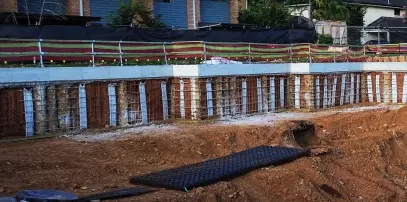
Wet-mix and dry-mix shotcrete
Wet-mix arrives batched, with the water already in it, and air at the nozzle drives it onto the face. Dry-mix arrives dry and picks up water at the nozzle, which puts mix control in the nozzleman’s hands. Australian civil work leans much harder toward wet-mix than most overseas markets, a difference the Australian Shotcrete Society sets out in its guidance for local practice. Batched consistency, lower rebound and steadier output on a basement face are the reasons.
Shotcrete as part of your ground support
A sprayed facing is ground support, and the WHS duties that attach to ground support attach to it. The SafeWork NSW excavation Code of Practice lists shotcrete among the ground support methods, and it expects a competent person to design support for the specific site conditions. Where an excavation goes below the footing of a neighbouring structure, the Code also expects a competent person to assess that structure before the dig starts.
That matters when the facing spans between nails on a boundary. The element controlling movement at that face is the element your neighbour feels first.
Shotcrete across Sydney and NSW
Our shotcrete supports a range of project types:
- Basement retention for commercial and multi-residential developments
- Soil nail and rock bolt walls on cut faces and batters
- Infill facing to contiguous, secant and soldier pile walls
- Rock face stabilisation in Sydney sandstone
- Rail and public infrastructure works, including corridor-adjacent excavation
- Facing to shoring designs prepared by others
At Collaroy Bathers for Lords Group we delivered shotcrete alongside 600mm to 750mm secant piles, the capping beam and temporary bracing. That is the usual shape of the work. The facing sits inside a wider retention scope rather than arriving as a standalone trade.
Why builders choose Millent for shotcrete
- Facing inside a complete shoring scope. Piles, capping beam, anchors, shotcrete and excavation priced together and sequenced as one program.
- In-house design. Our engineers detail the facing with the wall and the anchor layout, working from the project geotechnical report.
- Our own dig. The spray crew follows our excavation, so bench heights and stand-up times stay under one contractor’s control.
- In-house surveyor. Independent checks on face levels and as-built records against design.
- Restricted access capability. Basement benches, low headroom and boundary faces where standard plant will not fit.
- Family expertise spanning three generations of the piling industry. Repeat shoring work from tier one and tier two builders.
Our shotcrete equipment
Concrete placement
- Schwing SP 1000: Trailer-mounted stationary pump from a series built to handle grout, shotcrete and structural concrete. It sets up clear of the face and pumps down the line, which suits basement benches where the agitator stays at street level.
- Soilmec SKP80: Crawler-mounted pump built to work alongside CFA piling rigs, with pipe cleaning and washout gear carried on board. It tracks itself around the working platform rather than needing a tow and a set-up pad every time the face moves.
- Flowcrete FC7H8HT: Australian-built high-pressure line pump. Line pressure is what carries a low-slump mix down a long pipe run to a face in the far corner of a basement, where the pump has nowhere closer to stand.
- Transcrete MAX P35: Compact S-tube trailer pump, designed and built in Sydney for the harsh low-slump mixes used on Australian sites. Small footprint, so it works inside a basement or on a tight frontage where a larger unit would block the only access.
Supporting plant
- Excavators from 4.5t to 35t: Bench forming, face trimming and rebound clean-up, sized to the working platform and the height of the lift being sprayed.
See the full equipment list across our piling and shoring fleet.
Frequently Asked Questions
What is shotcrete used for on a construction site?
Shotcrete forms the face of a retaining or shoring wall. It spans between soil nails, rock bolts or piles and transfers retained ground back into them. On basement projects it holds the cut face as the excavation goes down, and on rock faces it seals defects that would otherwise ravel or weather during the program. It can serve as a temporary facing or stay in the permanent works, depending on the design.
What is the difference between wet-mix and dry-mix shotcrete?
Wet-mix arrives fully batched with the water already in it, and compressed air projects it onto the face. Dry-mix arrives dry and takes on water at the nozzle, which leaves mix control with the nozzleman. Australian civil work uses wet-mix far more than dry-mix, mainly for batch consistency, lower rebound and steadier output on large faces.
Can you spray shotcrete onto a soil nail or rock bolt wall?
Yes. That is one of the most common uses on Sydney sites. We cut the bench, install the nails or bolts, spray the face and move down to the next lift. Running the anchoring and the facing with the same contractor keeps the stand-up time of each open face inside what the design allows.
Is shotcrete a permanent wall or a temporary one?
Both, and the shoring design decides which. A temporary facing carries the excavation through construction and stops working once the permanent structure props the wall. A permanent facing stays in the works, so durability, cover, reinforcement and finish all step up. Send us the drawings and we will tell you which one you are pricing.
When does shotcrete happen in the excavation program?
Bench by bench, as the dig goes down. Each lift needs to reach strength before plant works below it or the next row of anchors stresses against the wall. That puts the facing on the critical path between the excavation and the anchoring, which is why we sequence all three together.
What do you need to price shotcrete?
The shoring drawings showing face treatment, reinforcement and thickness, plus the geotechnical investigation report. We also need the excavation sequence and bench levels, and a site layout marking access, crane pads and truck routes near the wall. Access to the face changes the price more often than the area of it does.