
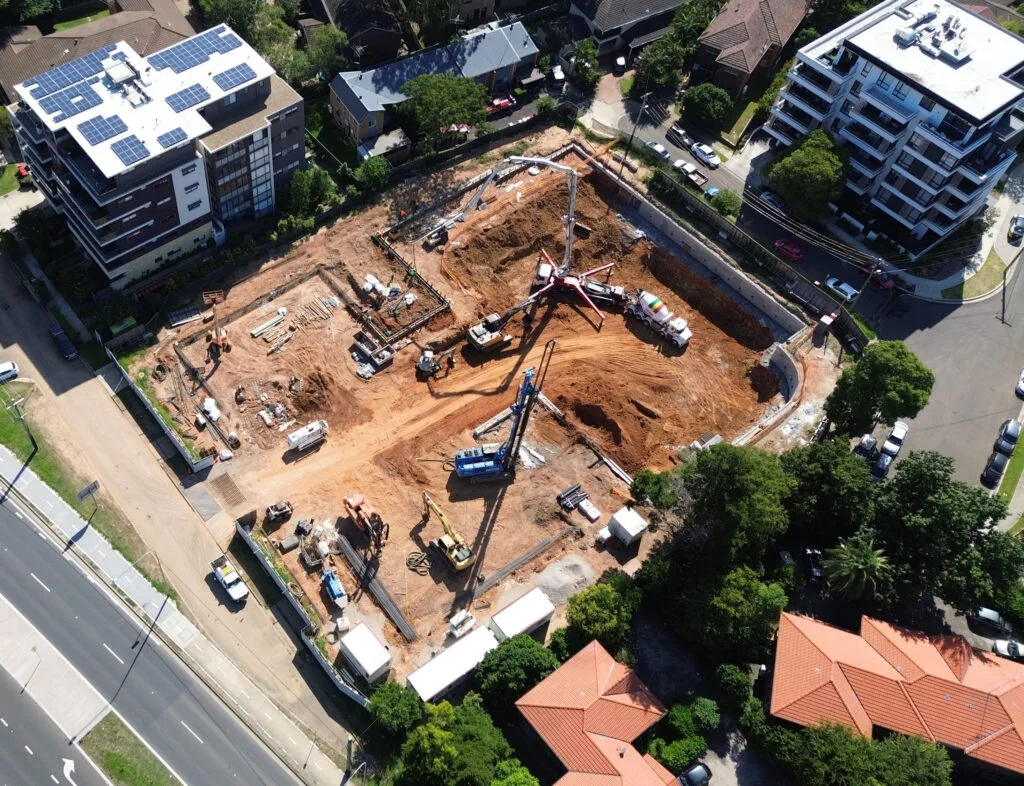
Bulk and detailed excavation are two different jobs on the same site, and mixing them up costs money. Bulk excavation moves the big volume, taking the site down to design levels as fast as haulage allows. Detailed excavation, by contrast, does the precise work that follows. Footings and pile caps, lift pits, trimmed faces: tolerance drives that work, not tempo. Treat them as one activity, however, and the program pays for the confusion.
What Bulk Excavation Covers
Bulk excavation is a production exercise. Large excavators load a continuous cycle of trucks. The measure of a good bulk dig is cubic metres out the gate per day.
On a basement job it takes the site from natural ground down toward base slab level. The dig happens inside whatever holds the ground up. Where there is room, batters do the job. Otherwise the ground needs a piled and anchored retention system.
The constraint is rarely the digging itself. Instead, truck movements, traffic management, wet weather and spoil disposal set the pace. For that reason, an honest bulk excavation price says as much about haulage as it does about the machine.
What Detailed Excavation Covers
Detailed excavation picks up where the big machines stop. Smaller excavators cut pile caps, strip footings, lift overruns, sumps and service trenches. They also trim the final faces and base to the levels the structure needs.
Tolerances tighten, machines shrink, and the surveyor becomes the most important person on the dig. Of course, it is slower by nature. It also runs interleaved with other trades, so the risk sits in coordination rather than volume.
Our excavation fleet runs from 4.5 to 35 tonnes across both types of dig. The machine matches the task instead of the task bending around the machine.
How The Two Fit One Program
On a shored basement, the excavation weaves through the retention works rather than following them. The sequence on an anchored wall runs in benches. First, bulk excavation takes the dig down to the first anchor level. Next we install and stress the anchors. The bulk dig then continues to the next level. Finally, detailed excavation follows across the base once the bulk dig finishes, cutting the pits and trenches.
For example, our project in Penrith moved 20,000 cubic metres of bulk excavation inside a 12-week program. That sat alongside 3,000 lineal metres of CFA piling and 175 anchors reaching 13 metres. Interleaving is exactly what a program that tight depends on.
An excavation contractor who also delivers the piling and anchoring removes the handover friction between benches. The same team controls both sides of the sequence.
Before You Start
Excavation sits inside high risk construction work under the WHS Regulation. Two obligations sit ahead of any dig, whatever its type:
- Lodge a free enquiry with Before You Dig Australia to obtain plans for underground services.
- Allow up to two business days, and treat the plans as evidence of presence rather than exact location.
- Prepare a site-specific Safe Work Method Statement before anyone breaks ground.
The consequences of skipping either are not abstract. SafeWork NSW reviewed incidents involving excavations and earthmoving plant across the state. It found that 74% of them resulted in serious injury or death. In fact, trench collapse and plant striking workers rank among the most common. In short, ground support, exclusion zones and service location separate a dig from an incident report.
Pricing The Dig Honestly
The line items that separate a reliable excavation price from an optimistic one rarely appear on the drawings:
- Spoil classification and disposal
- Groundwater handling
- Truck access and staging space
- Wet weather allowance
- Interface with the shoring and piling works
A contractor who prices the excavation and leaves the retention system out is pricing half the problem. Book a site assessment with our team. We will walk the block and read the geotech. Then you get an excavation and retention picture that survives contact with the ground.
FAQs
What is the difference between bulk and detailed excavation?
Bulk excavation removes large volumes of material to bring a site down to its design levels. Progress runs at cubic metres per day. Detailed excavation, by contrast, is the precise digging that follows. It covers footings, pile caps, lift pits and trenches, all to tight tolerances with smaller machines.
How does excavation work on a shored basement?
The dig runs in benches through the retention works. First, bulk excavation takes the site down to each anchor level. The anchors are installed and stressed, then the dig continues to the next bench. Detailed excavation then cuts the pits, trenches and final levels across the base.
Do you need a Before You Dig enquiry before excavating?
Yes. A free enquiry with Before You Dig Australia provides plans from underground asset owners before any digging starts. Plans show the presence of services rather than their exact location. Allow up to two business days for them to arrive.
Is excavation high risk construction work?
Excavation falls within high risk construction work under the WHS Regulation. That means you prepare a site-specific Safe Work Method Statement before work starts. SafeWork NSW found that 74% of reviewed incidents involving excavations and earthmoving plant resulted in serious injury or death.