
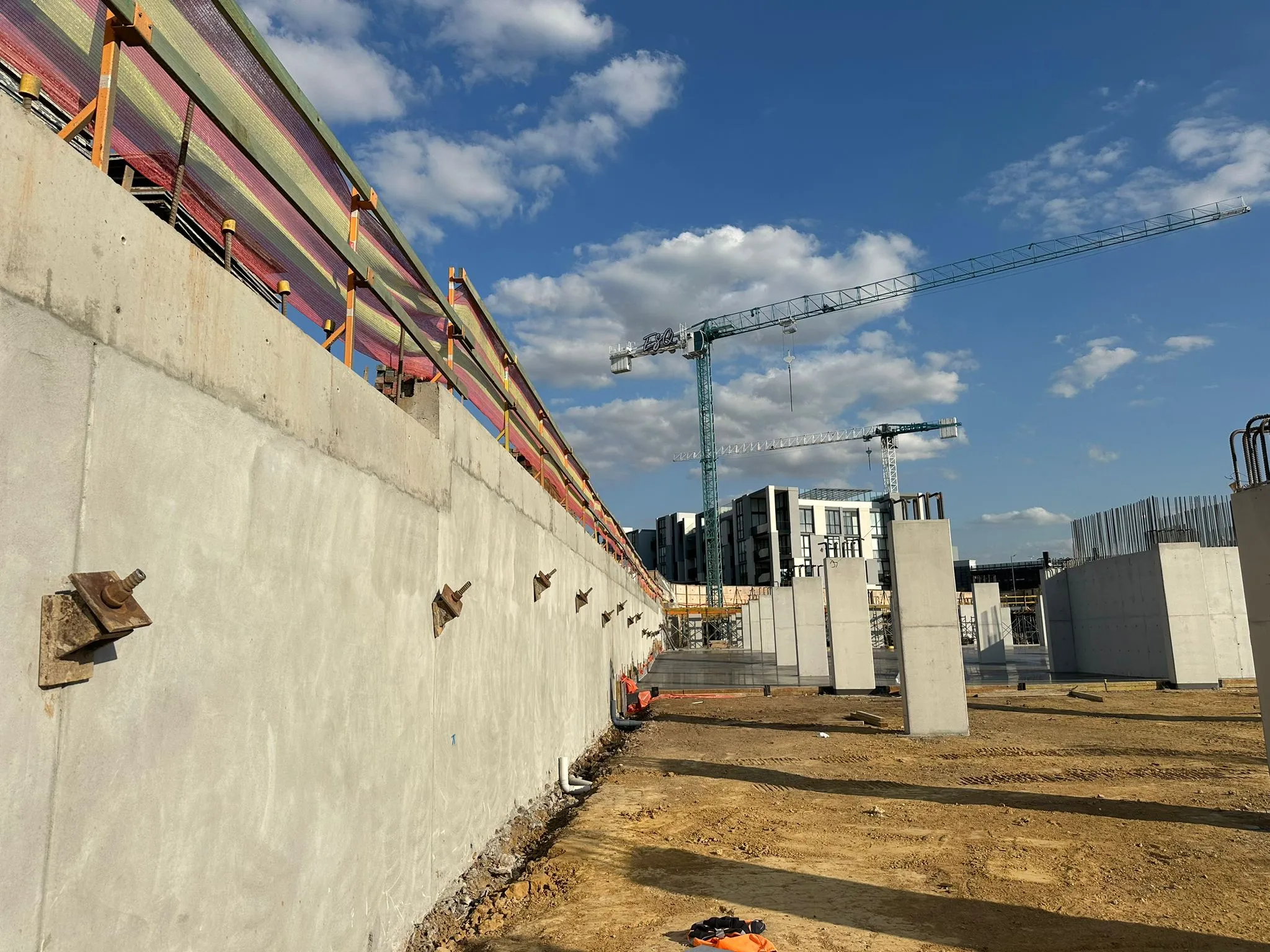
Rock anchors and soil anchors hold a retaining wall back the same way. A steel tendon runs from the wall to grout set in the ground at the far end, and we stress it to prove the load. The ground at that far end decides how long the anchor is and how we drill it. On a tight boundary, a longer anchor can end up under your neighbour’s lot.
We read the geotechnical report before we pick a rig. It tells us whether we’re drilling into rock, clay or sand. If you want the basics first, start with temporary vs permanent ground anchors. It explains how an anchor works and when it has to stay in for good.
Free length and bond length
Every anchor has a free length and a bond length. The free length passes through whatever sits between the wall and good ground. The bond length is the grouted stretch at the far end. It’s the only part that holds.
That grouted stretch has to sit beyond the wedge of ground the wall is holding back. A deeper cut means a longer free length before the bond even starts.
A rock anchor bonds to sound rock. A soil anchor bonds to soil or to soft, weathered rock. Grout holds better in rock, so a rock anchor usually reaches the same capacity over a shorter bond length. Soil needs more length and it’s harder to drill. Loose or soft ground keeps closing the hole behind the bit.
Our Tamrock TCH-700 drills ground anchors, soil nails and rock bolts through both soil and rock. We pick the anchor type from the geotechnical report and fit the rig to it. You can see the full rig list on our equipment page.
How Sydney ground changes the anchor
Three ground profiles come up again and again on our anchoring jobs:
- Hawkesbury Sandstone (CBD, eastern suburbs, North Shore): good bond over short lengths.
- Reactive clay over shale (Western Sydney): longer bond lengths to reach stable shale.
- Sand and alluvium near waterways: poor bore stability, which is where sand anchors come in.
The Australian Museum’s Sydney Basin overview describes Hawkesbury Sandstone as quartz-rich sandstone with interbedded shale. Those shale bands are soft. A sandstone site can still put one inside the bond zone, so we read the borehole logs and don’t assume “sandstone” means sound rock.
The same overview puts the Wianamatta Group shales above the sandstone. That’s why a basement in the eastern suburbs and one at Kemps Creek can end up with different anchors.
One site can cross more than one profile. A basement that starts in fill and clay and ends in sandstone will probably need soil anchors on the upper levels and rock anchors lower down.
How bond length shapes the boundary
More anchor length means more drilling, more grout and more hole behind the wall. On a tight boundary, that extra hole ends up under your neighbour’s lot. Rock anchors at short bond lengths can stay inside your own boundary. A soil anchor on the same line might not.
Access shapes the anchor as much as the ground does. At Chatswood Chase we installed anchors for Multiplex with 2.1m of headroom. Drill angle, tendon handling, grout delivery and stressing all change in that space. If your access is tight, our anchoring team can check rig fit against your drawings before the tender closes.
Whichever type goes in, we prove it by stressing. We record proof loads, lock-off loads and time-load behaviour against the specification. That way we measure the anchor’s capacity before the dig reaches it. Permanent anchors add corrosion protection and long-term monitoring.
Anchors under neighbours and roads
An anchor that runs under a neighbour’s lot needs a written agreement with that owner before anyone drills. We usually de-stress temporary anchors afterwards.
On class 2, 3 and 9c buildings, shoring and anchoring also need a regulated design, which sits under our design and construct service. NSW Government guidance says a registered structural or geotechnical engineering design practitioner prepares it, and the building practitioner lodges it on the NSW Planning Portal before work starts.
Under a public road you need consent under Section 138 of the Roads Act 1993. The NSW Planning Portal names the local council as the consent authority for unclassified roads. Transport for NSW may need to approve works on some other classified roads. Some councils ask for more. Woollahra Council’s ground anchor application wants a chartered professional geotechnical engineer to certify the rock.
Allow up to six weeks for council assessment, and put it in the program before the first pile goes in. At Penrith we installed 175 ground anchors to 13m for Astina inside a 12-week program. A job at that pace can’t wait on a late approval.
If you’ve only got time to send one document, send the geotechnical report to our estimating team. We’ll tell you where the bond zones fall, which anchor type each level needs and what that does to your tender.
FAQs
What is the difference between rock anchors and soil anchors?
The ground that holds the bond length. A rock anchor bonds its grout to sound rock, and a soil anchor bonds to soil or soft, weathered rock. That changes the bond length, the drilling method and how far the anchor reaches past the wall.
Do rock anchors need a shorter bond length than soil anchors?
Usually, because grout holds better in rock. The designer sets the final length from the geotechnical report, and stressing confirms it.
Which anchors suit Sydney sandstone?
Rock anchors suit Hawkesbury Sandstone, which gives good bond over short lengths in the CBD, eastern suburbs and North Shore. Interbedded shale can still leave a soft band in the bond zone, so the designer checks the borehole logs.
Do ground anchors under a public road need council approval?
Yes. Works in a public road need consent under Section 138 of the Roads Act 1993. The local council is the consent authority for unclassified roads, and Transport for NSW may need to approve works on some other classified roads. Allow up to six weeks for council assessment.
Does an anchor design need a registered engineer?
On class 2, 3 and 9c buildings, shoring and anchoring need a regulated design. A registered structural or geotechnical engineering design practitioner prepares it, and it is lodged on the NSW Planning Portal before work starts.