Piling and Shoring Equipment Sydney
The piling rigs, anchor rig, excavators and concrete pumps behind Millent's shoring work across Sydney and NSW, and the job each one is built for.
A piling contractor is only as good as the rig sitting on the platform. Millent Civil Works runs six piling rigs, an anchor drilling rig, a fleet of excavators, and four concrete pumps. That excavator fleet runs from 4.5 tonnes to 35 tonnes. Together, the whole line-up is matched to Sydney’s tightest sites as well as its largest. This page sets out what each machine does, the projects it has built, and the kind of job it suits. If you’re sizing up whether our equipment can handle your site, the access constraint usually answers that question first. The ground conditions come second.
Piling rigs: matched to the ground and the access
Six rigs cover our piling work. They range from large-diameter bored piles on open sites to CFA piling under headroom most contractors can’t get under. We pick the rig from the access and the pile spec, not the other way around.
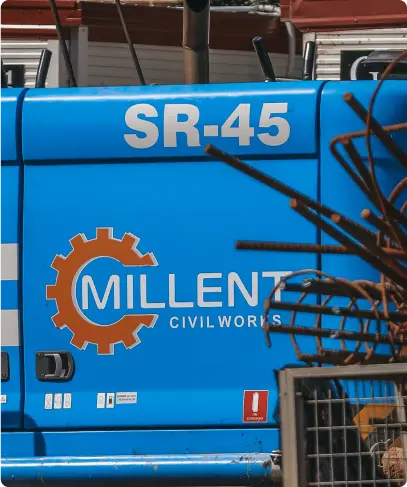
Soilmec SR-45
Large-capacity rotary rig for deep, large-diameter bored piles, CFA and cased piling. It’s the rig we send to high-rise and infrastructure foundations, where diameter and depth do the talking. At Kemps Creek for Hansen Yuncken, the SR-45 installed piles from 600mm to 1,500mm diameter, some reaching 20 metres deep. That was on an open Western Sydney site with room to move. At Botany Rail for John Holland, the same rig worked day and night shifts around live rail shutdowns. Even then, it still drilled tight against overhead signage.
Soilmec SR-20
Compact, self-erecting rotary rig for narrow and confined sites. It piles to around 1,200mm diameter and 40 metres deep, even where access is tight. Depth is still required in those spots, and that’s a combination most rigs its size can’t manage.
Bauer BG 15
Versatile mid-size rotary rig for cased and uncased bored piles and CFA. It’s the rig behind most of our residential and commercial foundation work. It’s also reliable on the job runs where a larger rig would be overkill, and a smaller one too slow.
Bauer BG 25
High-torque rig for larger-diameter, deeper piles, with low-headroom capability suited to basement and confined-height work. Where a job needs torque and a low mast together, the BG 25 covers both. That keeps the job on one machine instead of splitting it across two.
Soiltek S60
Compact restricted-access specialist, built around a modular multi-section mast for bored, CFA and down-the-hole work. It’s craneable into sites larger machines can’t enter. At The Ribbon Hotel for Multiplex, the S60 drilled CFA piles to 11 metres deep. It did that with just 5.5 metres of clearance beneath a concrete viaduct. It also worked alongside the SR-45 at Kemps Creek. There, it took the confined sections of the site while the SR-45 handled the open ground.
Tescar CF3
Lightweight, low-headroom rig for tight and restricted-access piling. Its narrow footprint and rubber tracks let it sit on surfaces and in spaces the rest of the fleet can’t reach.
Anchor rig: working where the headroom runs out
Millent runs a Tamrock TCH-700, a purpose-built anchor drilling rig for ground anchors, soil nails and rock bolts. It works across both soil and rock profiles. At Chatswood Chase for Multiplex, our anchor crew installed ground anchors with 2.1 metres of headroom. That’s a space standard anchor plant won’t stand up in. Drill angle, tendon handling, grout delivery and stressing all change inside two metres. So the rig and the crew have to be set up for it before mobilising, not worked out on site.
Excavators: sized to the platform
Our excavator fleet runs from 4.5 tonnes to 35 tonnes. So we size the machine to the bench, instead of bringing one machine to every stage of the dig. Confined basement benches and split-level sites take the smaller end of that range. Bulk excavation and open haulage take the larger end. At our project for Astina, that fleet moved 20,000 cubic metres of bulk excavation. Alongside it went 3,000 linear metres of CFA piling and 175 anchors, all inside a 12 week program. The smaller excavators in the range also carry the breaker attachments. Those trim pile heads to cut-off level ahead of a capping beam pour.
Concrete pumps: placement matched to the pour
Four pumps cover our concrete and grout placement. We choose between them on how the mix has to travel, not just how much of it there is.
- Schwing SP 1000: trailer-mounted stationary pump built to handle grout, shotcrete and structural concrete. It sets up clear of the face and pumps down the line. That suits basement benches where the agitator has to stay at street level.
- Soilmec SKP80: crawler-mounted pump built to work alongside CFA piling rigs, with pipe cleaning and washout gear carried on board. It tracks itself around the platform instead of needing a tow and a new pad every time the rig moves.
- Flowcrete FC7H8HT: Australian-built high-pressure line pump. Line pressure carries a low-slump mix down a long run to a face in the far corner of a basement. Nothing closer is available there to stand the pump.
- Transcrete MAX P35: compact S-tube trailer pump, designed and built in Sydney for the harsh low-slump mixes used on Australian sites. Its small footprint means it works inside a basement or on a tight frontage. A larger unit would block the only access there.
How access and depth shape change selection
The rig follows the constraint, and on most Sydney sites the constraint is headroom, diameter, or both.
- Open sites with large-diameter, deep piling: Soilmec SR-45
- Narrow or confined sites still needing depth: Soilmec SR-20
- Standard residential and commercial bored or CFA work: Bauer BG 15
- Larger-diameter piling under low headroom: Bauer BG 25
- Craneable access into sites nothing else can enter: Soiltek S60
- Tight, low-headroom piling on sensitive surfaces: Tescar CF3
- Ground anchors, soil nails and rock bolts under restricted headroom: Tamrock TCH-700
- Confined basement benches: excavators at the smaller end of the fleet
- Bulk excavation and open haulage: excavators at the larger end of the fleet
- CFA and bored pile pours: Soilmec SKP80
- Long pump runs to the far side of a basement: Flowcrete FC7H8HT
- Tight frontages and confined pours: Transcrete MAX P35

Piling and shoring equipment across Sydney and NSW
Our piling and shoring equipment covers a wide range of project types:
- Small to large residential buildings, including basements and difficult-ground sites
- Medium to high-rise commercial structures
- Public and industrial infrastructure, including rail
- Restricted-access and low-headroom sites beneath existing structures
- Deep basements and split-level sites requiring a full retention system
Most of that equipment works across more than one service. The rigs that pile also often sit beside the excavators trimming pile heads for a capping beam. In turn, the pumps that place a CFA pile also spray shotcrete on the wall it forms. See how the fleet supports each service on our piling, anchoring and excavation pages. Alternatively, see how it comes together under one contract with design and construct.
Why builders choose Millent for our fleet
- Rig matched to the constraint, not the other way around. Six piling rigs and an anchor drill cover restricted headroom, close-to-boundary and large-diameter work without subletting to a second contractor.
- Smart data recording and pile integrity testing. Drilling parameters and pressure-meter tests are recorded on every rig, backed by testing in line with AS 2159.
- In-house mechanic. Our own workshop maintains the fleet, keeping breakdowns off the critical path.
- In-house cage production. Pile cages come from our own yard, so cage supply never holds up the rig.
In-house surveyor. Independent set-out checks on every pile, anchor and excavation level, run apart from the crew doing the work. - Three generations of family expertise. Repeat work from tier one and tier two builders across the fleet’s whole range.
Frequently Asked Questions
What piling rigs does Millent Civil Works use?
We run six piling rigs. They are the Soilmec SR-45, SR-20, Bauer BG 15, BG 25, Soiltek S60 and Tescar CF3. Between them, they cover large-diameter deep piling and standard residential and commercial bored and CFA work. They also cover tight, restricted-access and low-headroom sites.
Can your equipment work under low headroom?
Yes. The Soiltek S60 and Tescar CF3 are built for tight and restricted-access piling. The Tamrock TCH-700 anchor rig installed ground anchors with 2.1 metres of headroom at Chatswood Chase for Multiplex. The Soiltek S60 also drilled CFA piles to 11 metres deep at The Ribbon Hotel for Multiplex. It did that with 5.5 metres of clearance.
What is the largest pile diameter and depth your fleet can install?
Our Soilmec SR-45 handles large-diameter, deep bored, CFA and cased piling. At Kemps Creek for Hansen Yuncken it installed piles from 600mm to 1,500mm diameter, some to 20 metres deep.
Do you own your excavators or hire them in?
We run our own excavator fleet, from 4.5 tonnes to 35 tonnes, maintained by our in-house mechanic. That range covers confined basement benches through to open bulk excavation. It includes the 20,000 cubic metres moved at our Penrith project for Astina.
How do you choose which concrete pump to use?
The choice follows how the mix has to travel, not just the volume. Crawler-mounted pumps track around a piling rig for continuous CFA pours. Line pumps, on the other hand, carry low-slump mix long distances to a basement’s far corner. Compact trailer pumps then fit tight frontages, where a larger unit would block access.
Do you provide pile integrity testing?
Yes. Every job is backed by pile integrity testing and smart data recording. That covers drilling parameters and pressure-meter tests, in line with AS 2159. Independent verification then comes from our in-house surveyor.