
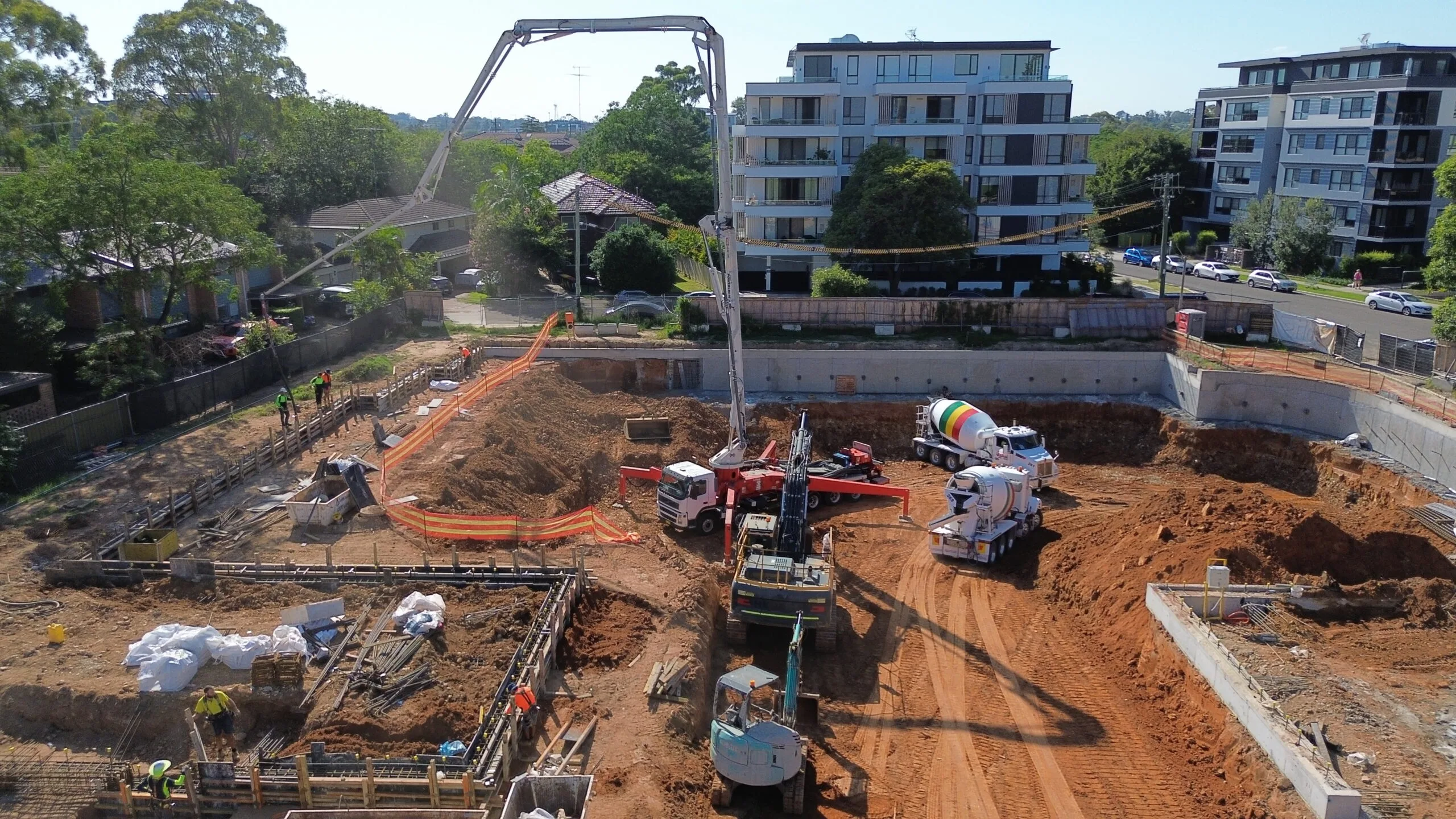
The CFA vs bored piles question comes up on almost every foundation package we price. But in most cases the ground has already decided. Sydney’s geology changes street by street. Sandstone sits at shallow depth across the east, reactive clay over shale through the west. Get down near Botany Bay or the river flats and it’s loose sand with high groundwater. Fight those conditions and you pay in refusals, redesign, program slip. Work with them and piling turns into the least dramatic trade on site.
CFA vs Bored Piles: The Short Answer
Bored piles suit deep foundations, large diameters and rock sockets. The open bore lets the crew case through poor ground and inspect the founding material. A full-depth reinforcement cage goes down before the pour.
CFA piles suit unstable soils and disturbance-sensitive sites. The auger supports the bore at every moment, and the rig installs each pile in a single low-vibration pass.
Still, most Sydney projects could physically use either. The right answer depends on what sits under the site, what stands next to it, and what the structure asks of every pile. So that’s the assessment we run on every piling project we tender across Sydney. It starts with the geotechnical report, not the rig list.
How The Method Forms the Pile
Rotary Rig Formation
A rotary rig drills the bore with a kelly bar and auger, removing spoil as it goes. Where the ground won’t stand open, temporary casing supports the bore. The crew inspects the spoil coming off the auger and confirms the founding material. Then a reinforcement cage goes down to full depth, and only after that does concrete. That visibility is the real advantage. You know the founding material before a drop of concrete goes down the hole.
CFA Rig Formation
A continuous flight auger with a hollow stem drills to design depth in one pass. The operator then withdraws the auger slowly while concrete pumps through the stem. The bore never stands open. The crew then plunges the reinforcement cage into the wet concrete.
It’s fast, quiet and low-vibration. But the plunged cage limits how deep heavy reinforcement can reach, and the crew never sees the founding material directly. Modern rigs offset that with instrumentation. Ours record drilling parameters and concrete pressures on every pile, so the data confirms what the eye can’t.
Where bored piles work
Strong rock settles the argument. Much of eastern Sydney and the North Shore sits on Hawkesbury Sandstone at shallow depth. A CFA auger that reaches strong sandstone stalls where a rotary bored rig with rock tooling keeps cutting. Bored piles socket into the rock and carry high-rise loads on short, stiff piles.
Bored piling also wins on sheer scale. When the design calls for large diameters, deep toes and heavy full-depth cages, only the open bore delivers all three. At our Kemps Creek project for Hansen Yuncken, that meant 600, 1,200 and 1,500mm diameter piles up to 20m deep.
Western Sydney adds one more reason. The reactive clays out here move with the seasons, so shallow footings move with them. We take piles through the clay and found them in the shale beneath. You want to confirm that founding level pile by pile.
Where CFA is the right call
CFA earns its place in loose sand and high groundwater. An open bore in saturated sand wants to collapse. A CFA bore can’t, because the auger occupies it until concrete replaces it. That makes CFA a natural fit near waterways and anywhere the water table sits high.
SafeWork NSW’s excavation guidance treats ground collapse as a top-order risk on any site that opens the ground. A method that never leaves a bore open removes that risk at the source.
CFA also suits neighbours. Low noise and minimal vibration make it the default pick beside occupied buildings, schools, hospitals and rail corridors. A driven or heavily percussive method would trigger complaints or breach vibration limits.
And when the ground suits it, nothing matches CFA for production. We put down 3,000 lineal metres of CFA piling at Penrith inside a 12-week program. That same program carried 175 anchors and 20,000 cubic metres of bulk excavation.
Six deciding factors
Run the CFA vs bored piles decision against these six factors.
- Founding material: rock sockets and inspected founding levels favour bored piles.
- Groundwater: a high water table favours CFA, or bored piles with casing.
- Reinforcement: full-depth or heavy cages need an open bore, and plunge depth caps CFA cages.
Neighbours: occupied buildings and rail corridors favour low-vibration CFA. - Diameter and load: large-diameter, high-capacity piles sit firmly in bored territory.
- Program: in suitable ground, CFA’s single-pass cycle outpaces bored piling metre for metre.
If the geotechnical report is still in draft, that’s the moment to test the method against the design. Book a site assessment and we’ll walk the ground before the job goes to tender.
Whichever method wins, prove the pile
Method selection gets the attention, but verification protects the structure. Both pile types fall under AS 2159, the Australian Standard for piling design and installation. It covers geotechnical and structural design through to construction and testing.
On our jobs that means pile integrity testing plus smart data recording of drilling parameters and pressure-meter tests. Then an in-house surveyor runs independent set-out checks on top of that. A pile you can’t verify is a pile you’re guessing about.
The method call belongs early, at feasibility or tender stage. There’s still time then to shape the design around the ground instead of fighting it later. Send your geotechnical report and structural drawings to our estimating team for a site-specific method recommendation and piling price. We’ll tell you straight which method your site wants.
FAQs
What is the main difference between CFA and bored piles?
A bored pile stays open while the crew drills it. That lets them inspect the founding material and place a full-depth reinforcement cage before concreting. A CFA pile forms in a single pass through a hollow-stem auger. As a result, the bore never stands open in saturated ground.
Which piling method suits high groundwater?
CFA piling suits high groundwater because the auger supports the bore until concrete replaces it. The bore never stands open in saturated ground. Bored piles can also work below the water table when temporary casing supports the bore.
Can a CFA rig drill into rock?
CFA piles struggle in strong rock such as Hawkesbury Sandstone, where the auger stalls before reaching a socket. Instead, bored piling rigs with rock tooling handle rock sockets, common across eastern Sydney and the North Shore.
Is CFA piling faster than bored piling?
In ground that suits it, yes. The single-pass drill-and-concrete cycle means CFA rigs typically install more metres per shift. Bored piling takes longer per pile but remains the only option for rock sockets, large diameters and full-depth reinforcement.
Do CFA piles have reinforcement?
Yes. The crew plunges a reinforcement cage into the wet concrete immediately after the pour. Plunge depth caps how far that cage reaches. In a bored pile the cage sits at full depth in the open bore before any concrete goes in.